
We have seen key feed ingredient prices start to increase over the last few weeks with soya in particular firming. Molasses prices in the UK have remained relatively stable over the last year or so, however with currency weakening over the last few months this is putting upward pressure on prices. It’s therefore a good time to buy as prices wont be coming down over the winter.
Whether you are feeding dairy, beef or sheep we continue to see strong demand for molasses for a number of reasons.
- Managing forage stocks: Lack of winter forage means many livestock farmers are relying on straw to make up the shortfall. High protein molasses blends are ideal to make this work effectively
- There is a major shortage of moist feeds and liquid coproducts. A molasses blend is an ideal alternative to these products with the added benefit of a guaranteed specification and being available in load sizes to suit (1mt to 29mt)
- With milk price coming under pressure it’s vital to optimise feed usage, using a molasses blend can increase dry matter intake, reduce feed wastage and increase rumen efficiency
- The feed and livestock industry now recognises the unique nature and absolute need of sugars in ruminant diets, research has shown that 6-8% sugars in well balanced dairy and beef diets optimises performance
- Molasses based liquid feeds represent the most cost effective source of sugars available
Can you afford not to be feeding an ED&F Man Molasses blend this winter?
Winter Rations
This season has brought significant variability in forage quality and composition, presenting both challenges and opportunities for dairy, beef or sheep farmers. The stark differences in regional weather has led to an extreme range of silage quality, with Dry Matter (DM) content ranging from 33.6% to 43%. Average lactic acid levels have dropped from 74.8 to 70.8 g/kg DM, indicating a decline in fermentation quality. Drier silages with lower lactic acid and higher volatile fatty acid (VFA) levels are more prone to yeast and mould development, which can increase the risk of heating and spoilage, further compromising ration quality. Digestibility values also vary significantly, from 62.8% to over 68%, suggesting that some silages offer lower feed value. In this context, regular forage analysis is critical to ensure diets are accurately balanced and adjusted to maximise performance.
While Total Fermentable Carbohydrates (TFC) have seen a slight increase, the proportion of Rapidly Fermentable Carbohydrates (RFC)—the fraction most readily available to rumen microbes—has declined. This change means that although cows may be consuming similar overall carbohydrate levels, the speed and efficiency of energy release in the rumen is compromised.
For nutritionists, this signals a need to rebalance diets to restore synchrony between energy and nitrogen release in the rumen. RFC sources such as cereals or molasses can play a vital role in this adjustment, helping to maintain rumen microbial activity and support optimal performance.
Compounding the issue, both total and rapidly fermentable protein levels are also down. This can limit rumen microbial activity and microbial protein synthesis, negatively impacting cow performance. Targeted supplementation with rumen-degradable protein (RDP) sources—such as urea-treated grains or specialised protein blends—alongside rumen-protected amino acids, will be essential to meet protein requirements and support overall productivity.
Additionally, with a falling milk price it is key that animals are efficient as possible to maximise margins on farm. The historical method of overfeeding crude protein in order to meet cows amino acid requirements is inaccurate and expensive, therefore, focussing on a more precise protein feeding method can help improve margins as well as animal health and performance in the long term.
Low forage stocks are forcing many farmers to adapt winter rations, with additional concentrate feeds to eke out forage supplies or incorporating straw into the diet. Straw is harder for rumen microbes to digest, which can lead to reduced intakes and suboptimal performance. Straw feeding, whether partially or fully replacing grass silage, presents challenges in palatability, digestibility, and protein availability.
Molasses blends can help overcome these issues by enhancing fibre digestion and providing fermentable energy. Independent research has shown that replacing 7.5 kg of grass silage with 1.5 kg wheat straw and 1.5 kg Regumix maintains production while preserving valuable silage stocks. When implementing straw-based rations, a two-week adaptation period is recommended, along with gradual dietary changes and additional mineral supplementation. Ensuring access to fresh water is also critical.
This year’s forage variability demands a proactive and flexible approach to ration formulation. By leveraging molasses-based liquid feeds, producers can enhance dry matter intake, balance carbohydrate supply, and improve protein efficiency—ultimately supporting animal health, performance, and profitability. Planning ahead and maximising feed utilisation will be key to navigating the winter months and maintaining margins despite falling milk prices.
Optimising Diets with Molasses-Based Liquid Feeds
Regardless of whether you are feeding dairy beef or sheep, given the variability in forage quality, achieving the ideal sugar level in the diet between 6-8% is key to cost-effective production. Molasses-based liquid feeds offer a strategic solution, supporting animal health and performance through three core pillars:
1. Driving Dry Matter Intake (DMI)
High-performing livestock often struggle to maximise DMI when fed solely on dry ingredients, this will be the case across most herds this winter with the drier silages also negatively impacting intakes. Incorporating an ED&F Man molasses blend into the ration can significantly boost intakes due to its liquid nature and low substitution effect. Molasses blends are highly palatable, encouraging animals to eat more—an essential driver of both milk yield and daily live weight gain.
2. Balancing Starch and Sugar
Synchronising carbohydrate supply—through both sugar and starch—is crucial for rumen health and performance. While ground cereals are good value this winter for providing energy, excessive starch feeding can increase the risk of sub-acute ruminal acidosis (SARA). To mitigate this effect, it is advised to increase the sugar levels of the ration to 6-8% in replacement of starch while holding overall starch + sugar level. Research shows that adding a molasses-based liquid
feed helps keep the rumen environment balanced. Replacing some starch with sugar can help reduce the indecencies of SARA and help maintain performance.
Molasses blends deliver rapidly fermentable sugars that energise rumen microbes more efficiently than starch improving rumen function and overall ration digestibility. ED&F Man’s molasses blends are formulated to deliver a synchronised supply of energy and protein, helping to offset the shortfall in rapidly degradable protein and optimise microbial protein production.
3. Improving Protein Efficiency
Effective rationing means meeting animal requirements without overfeeding nutrients like protein, which can lead to wasted energy and increased nitrogen excretion. Cows require essential amino acids, not crude protein, by focussing on improving protein efficiency this is not only economically beneficial but also supports environmental sustainability. Through precision protein feeding, focusing on individual amino acid requirements rather than crude protein levels
helps reduce overfeeding of crude protein lowering nitrogen waste and pollution.
With many producers moving away from soya in diets, alternative protein sources are in demand. ED&F Man’s Regulated Release range of high-performance protein liquid feeds offers a synchronised source of RFC’s and RDP. Based on urea and sugar, these research-backed blends improve nitrogen efficiency, animal performance, and health. New research using ED&F Man’s ReguSmart 27 blend, a blend of Regulated Release proteins and MetaSmart, a methionine supplement, can further support precision protein feeding. More information on this blend later in the newsletter.
ReguSmart 27
Around 85% of UK dairy diets are deficient in the amino acid methionine. However, correct supplementation can have a positive effect on cow performance and efficiency. Molasses based liquid feeds are well known for improving dry matter intakes, milk constituents, fibre digestion and rumen function. Combining these benefits with a proven source of protected methionine in the form of MetaSmart has created a practical and easy way to deliver the methionine needed to help cows perform to their potential.
ReguSmart 27 is a high dry matter liquid feed with 53% sugars, 27% crude protein with the optimal inclusion of digestible methionine with MetaSmart. It is formulated to be fed at 1.4kg/day to delivery over 9g of digestible methionine and is designed to help drive production and efficiency from home grown forages. Speak to your local ED&F Man Commercial Manager for more information and how MetaSmart can be added to your ED&F Man molasses.
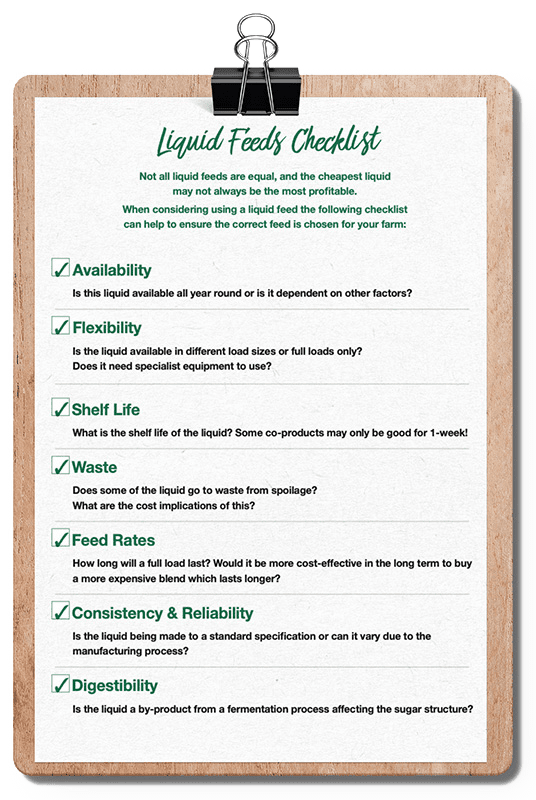
Liquid Feed Checklist
Many co-products from other industries such as pot ale syrup, whey and draff that historically would be found on farm are more and more commonly becoming unavailable to farmers as they are sold to anaerobic digesters as feedstock. These are not small volumes either; it is tens of thousands of tonnes of raw material that is taken off the market as a feedstuff for cattle which needs to be replaced.
Typically, the liquid co-products that were on farm were low dry matter products that were inconsistent specification due to being a co-product of another process rather than made as a feed. Despite this, these liquids have been utilised effectively on many farms, however, the value of using a liquid feed is becoming clearer as it offers a consistent, reliable and available alternative to these syrups.
So, when it comes to choosing a liquid feed to use on farm it’s important to remember that not all liquid feeds are equal, and the cheapest liquid on offer may not always be the most valuable. While cost per metric tonne is important, this is less crucial if it can’t be combined with:
For efficient and cost-effective production, livestock rations need to be consistent in terms of both nutrient content and ingredients uses. When a ration is changed, it can take up to 2 weeks for the rumen to adapt to the new ration and return to optimum levels of performance. ED&F Man Liquid feeds are manufactured to a guaranteed specification and are produced to order, giving users the confidence to build a ration that can be consistent and reliable in terms of quality, nutritional value and availability.
Storage Options
We are seeing strong interest in both new tanks and in replacement parts as customers look to recommission tanks not used for some time. ED&F Man can help you source everything from a complete tank and stand through to replacement valves and other ancillaries. Remember that our Tank Finance scheme means there is no upfront cost and that payments can be spread over 2 years interest free. We offer tank sizes to suit individual customers needs from 12-42mt.
Boosting Soil Fertility And Crop Growth
ED&F Man offer a range of molasses based Crop Nutrition products which improve soil fertility and work with natural processes to improve crop performance. Increasing soil organic matter and improving soil carbon sequestration is at the forefront of sustainable agricultural practice. Soils with an enhanced carbon content and organic matter typically have better structure, more stable nutrient levels and are less prone to soil erosion leading to better plant growth. Our range of products are formulated to suit specific customer needs.
Black Label: A concentrated carbohydrate and sugar source, can have a big impact with a modest inclusion and application rate. With its excellent mixing capacity, it’s ideal to add to fungicide and herbicide for assurance of efficacy. The anti-scorch properties are proven in field trials, and the chelating activity means users have reduced inorganic nitrogen use by a minimum of 10% over the crop growth season.
Gold Label: A blend of cane molasses and fermentation co products from the sugar industry resulting in a blend of naturally high levels of carbon and amino acids, beneficial to soil health and aiding germination and early establishment. The plant-based micronutrients supplied in this biological complex help facilitate the restructuring of inorganic nitrogen into amino acid building blocks for protein synthesis.
Blue Label: A blend of cane molasses, sugar co-products, and a concentrated Ascophyllum nodosum seaweed extract. The seaweed provides a boost of nutrients as it is particularly high in amino acids, enzymes, polysaccharides, fatty acids, organic glutamine, and bioactive peptides. Blue Label helps
enhance the plants own biochemistry boosting efficiency and growth mechanisms in the developing crop.
Red Label: A blend of cane molasses, fermented sugar co-products and a humic and fulvic acid combined with high free sugar and organic carbon levels, Red Label acts as an ideal accompaniment to liquid fertiliser and crop protection spray applications. Aids nutrient uptake and elemental trans-location into plant cells, and chemical pathways in soil and root systems. Leading to better soil structure and improved yields.
Transport Update
ED&F Man Transport works with some of the best and most reliable molasses hauliers in the country to cover the whole of the UK delivering molasses in volumes ranging from 1mt to 29mt.
Our six dedicated farm vehicles can be seen up and down highways and byways in the UK sporting their distinctive ED&F Man livery. Last year they covered 440 thousand miles delivering to our farm customers. The use of our rigid vehicles enables us to deliver to all sizes of farms and with their exceptional maneuverability means they can access even the most challenging of locations. The drivers of these vehicles have many years of experience in farm delivery and
will go out of their way to help the farmer in whatever way they can.
Delivery and order processing is run by our transport teams in Avonmouth, Grangemouth and Liverpool who pride themselves on giving the best possible service.
Sustainability Update
At ED&F Man we continue to invest in improving the sustainability of our business. Over the last 12 months we have installed solar panels in our Hull Terminal and upgraded our forklift trucks in Hull and Liverpool to electric power. As part of the Carbon Trust, we record and track all of our emissions and are able to supply carbon footprint data for all of our deliveries. We are proud to say we are a key part of the renewable energy program, supplying products into Biogas
production and certified sustainable molasses into the manufacturing sector. We constantly work to ensure we minimise our environmental impact as part of our ISO14001 certification and develop sustainable solutions in all areas of our business.